

Great Doubt
as a conscious commitment to uncertainty

PRIVATE TEACHING | CALENDAR | PODCAST | WRITING
There are three principles in Zen that are also important mental qualities in life, and these are doubt, faith, and determination. On the surface, doubt seems like an undesirable quality, not something we’d want to cultivate or feel much of if we can help it. Doubt is uncomfortable and destabilizing. It’s the voice that says, “I don’t know enough, I don’t do enough, I am not enough,” and it evokes such a painful feeling of inadequacy in us that we’ll do anything to avoid it. We’ll work ourselves to the bone, looking for the praise or the titles or the wealth that will bolster our sense of self worth. We’ll accumulate knowledge because we equate knowledge with certainty, and certainty with safety. We’ll avoid being quiet enough or still enough to catch even a glimpse of that doubt, but if it does appear, we’ll just blast it away with a quick jolt of pleasure—a pint, a blunt, a reel or two.
Small doubt—which the sutras call “hindering or skeptical doubt” (vicikiccha)—doesn’t even always look like doubt. It can look like resistance. It can look like shyness. It can look like hesitation, low self-esteem, or obsessive thinking. But whatever its form, small doubt is recognizable by its one distinctive characteristic: an utter disregard for our benefit. Small doubt doesn’t have our back. It isn’t interested in what might be helpful or clarifying. It’s not invested in transformation. Small doubt likes things to remain the same. It wants you to stay home, not make waves, not step outside your box because there’s no point, and because someone else will probably do what you’re trying to do, and they’ll do it better.
Now consider great doubt, which reminds us that there’s always a gap between what we know and what’s possible. Great doubt is humility and curiosity rolled into one. It doesn’t make us question ourselves or our worth or cause us to downplay others. It doesn’t shake our principles. It doesn’t challenge our capacity. Great doubt is expansive. It reminds us that the only way to grow is to take a chance, to venture beyond our comfort zone and into the unknown because in the known we can only repeat ourselves. This is painfully obvious on paper, but when it’s us at the edge of that cliff, doubt can be paralyzing. Just because it’s great, it doesn’t mean it’s not uncomfortable or frightening. But more frightening, we realize at some point, is to remain stalled. Once we’ve exhausted all the old ways of being, what other option do we have but to start looking for what we haven’t imagined?
That’s when great doubt first appears—when we take a good look at our minds and wonder, Why is it so loud in here? Or when we look at the world and ask, Why is it so messy out there, so painful? Does it have to be this way, or is there another choice? Is there something I can rely on that is true, that’s trustworthy, that won’t change with the next fad, the next trend? Great doubt is an engine. It gets us going on the path, and it keeps us going, until the tension between what we see and what we don’t is resolved. This means that working with great doubt is, in great part, building resilience. We have to learn to tolerate our discomfort. We have to make room for the tension and not move to diffuse it. We have to bear our not knowing and not bolt when we get afraid.
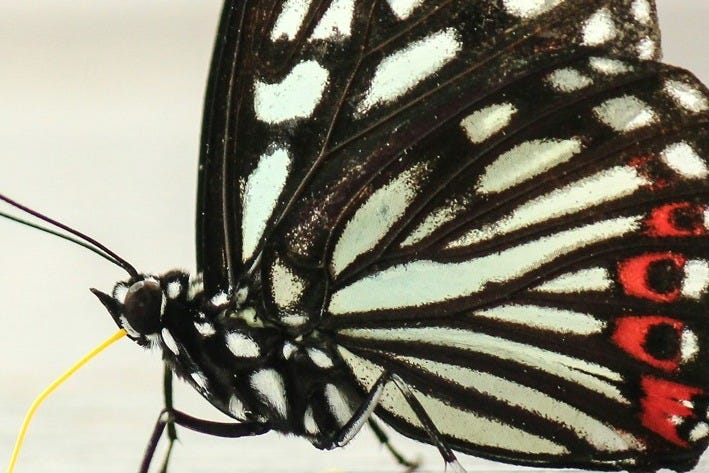
Think of the transformation a caterpillar undergoes to become a butterfly. This “rumble” (more properly called eclosion) is accompanied by enormous tension. To fight its way out of her chrysalis, a butterfly traps air to inflate her body and uses hydraulic pressure from her abdomen—which is filled with a fluid called hemolymph—to push outward against the wall of her casing. Once the shell splits, she squeezes out, antenna first, wiggling her swollen body out and hanging upside down to let gravity pump the liquid from her abdomen into her wings. Slowly, the wings fill out and stretch to their full size, like a flat hose inflating, then harden and dry out as the excess liquid drains back into the butterfly’s torso. It’s that intense pressure in her body that breaks the chrysalis wall and pumps the fluid into her wings. Without it, she’d remain trapped or grow out deformed and unable to fly.
We too need great tension to break out of our bonds. Doing nothing or doing little isn’t going to cut it.
I once took a class with Cynthia Bourgeault, a contemporary Christian mystic, in which she said that to perceive the world in a nondual way, we have to upgrade our operating system. The binary operator built into our brain can only perceive dualistically, in terms of subject and object, self and other, inside and outside. I call it our “spreadsheet mind,” and it’s very useful to balance a budget or map out a training routine. We need it to cross the street, conduct a meeting, or do all sorts of necessary, everyday tasks. But spreadsheet mind is hopeless if what we’re trying to do is get clear about ourselves and the world. It won’t help us attain liberation—very aptly called, among other things, “the unbinding.”
If we want to be free, we have to be willing to function in a way we haven’t before, or at least consider the possibility that there is such an option. We must be willing to upgrade, even though we don’t really know what we’ll get when we do. This is where faith and determination come in. Small doubt would have us stay safely cocooned inside our spreadsheet mind, drawing up carpooling schedules and investment charts, while great doubt is straining against the seams of that chrysalis, rearing to shake out its wings. We need enough trust to know we’ll be okay making such a mind-boggling transformation, and we need the energy to see it through. That’s why someone—I forget who—called great doubt a conscious commitment to uncertainty. Conscious and courageous, I’d add. Sometimes it’s exhaustion that gets us moving. We can no longer fathom dealing with ourselves in the old, worn out ways. But often it’s courage that sets us on the path, the conviction that there is a better way to live, coupled with our determination to find it.
If you’re not sure which kind of doubt is driving you, listen to the quality of its voice. Small doubt is often quiet but insidious, like a whispered rumor or like mold spreading behind a wall. Let it grow unattended and before you know it, your whole house is rotting. Or it can be loud, when masking as arrogance, but equally noxious because it razes everything in its path. Great doubt is quiet too, at first, but then it builds in volume and intensity until it’s all you can feel. That’s what causes the discomfort. But look closely and you’ll notice that great doubt, besides being uncomfortable and a bit scary, is also exciting. Some part of you does want to live more fully than you have, and that’s the kind of unease you want to nurture. It’s what keeps you straining against those walls, even though you don’t have any idea what you’ll find when you break them open. Great doubt says, I don’t really know what’s going on, but I think I can find out. I may only be able to see so far, but I can sense that on the other side of this chitinous wall, there’s a whole world. And I want to see it.
If you benefit from my writing, please consider sponsoring this newsletter or offering a donation through my website. Writing is long, patient work (and I wouldn’t have it any other way), so please know that even small gifts make a huge difference. Spreading the word also helps, so feel encouraged to do that too. Thank you, always, for your presence, your practice, and support.

Dear Zuisei, capturing this moment of needed transformation in your meticulous words, you are the wise one I seek. The tension which characterizes Great Doubt arrives in juxtaposition to the ooze of ease tech promises. I ooze. And then the blinding monarch flutters by to remind me. Thanks for being this delicate, vibrant, evolved archetype and guide.